02 / 06·2026
Worklogs
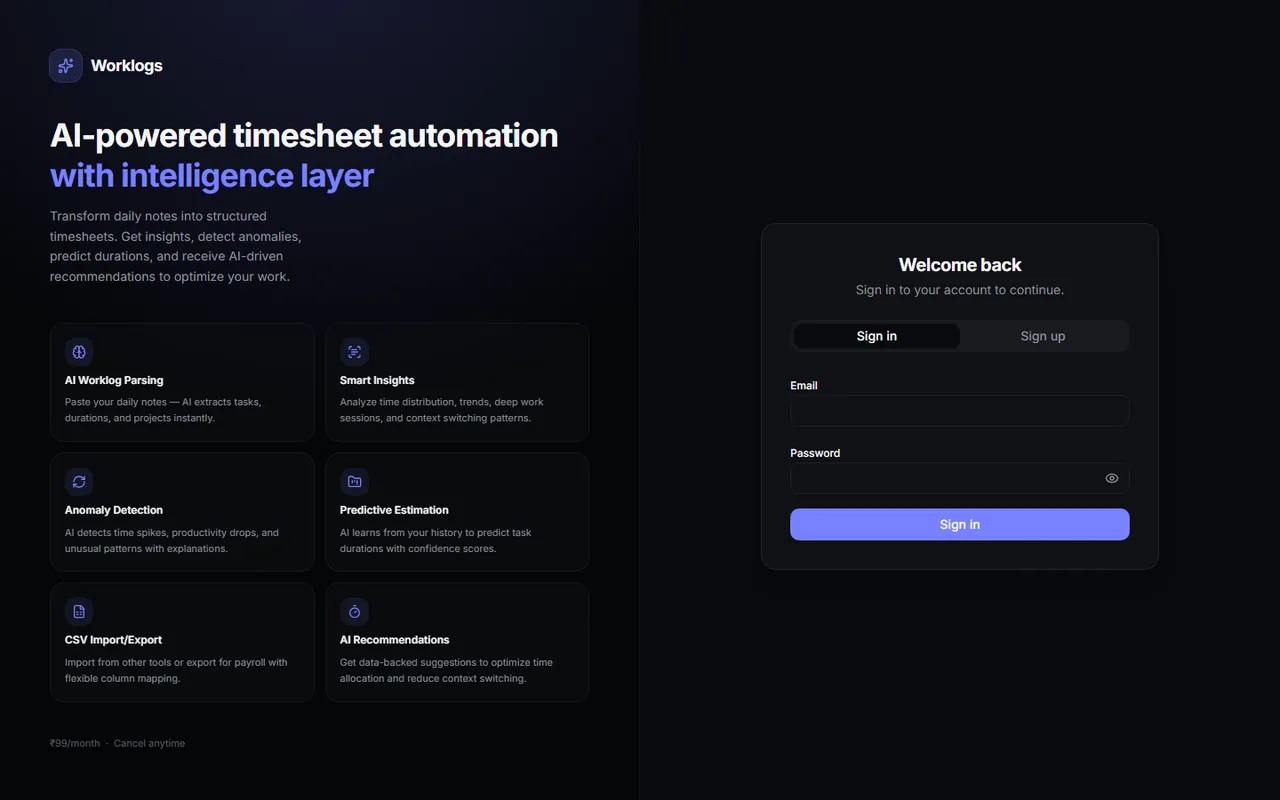
Daily notes in, Kimai timesheets out — with an intelligence layer on top.
- Role
- Full stack, AI pipeline, browser extension
- Source
- Private repo
01
Context & my role
A productivity tool for teams that log time in Kimai, used daily against a real Kimai instance.
I built all of it: the TanStack Start app, the AI parsing pipeline, the Supabase edge functions and the browser extension.
Role: Full stack, AI pipeline, browser extension
00
At a glance
Daily notes · photo · CSVInput
GPT-4o text + vision parserAI step
Tesseract.js and regex fallbacks
Learned duration estimatesProcess
per-task confidence
Human approval of draftsGuardrail
nothing saves unapproved
Idempotent sync queueGuardrail
retries · idempotency keys
Kimai timesheetsOutput
How the system works, top to bottom. Accent steps call a model; dashed steps are rules enforced in code, so the model cannot override them.
AI step Guardrail enforced in code Processing
02
Problem
Logging time in Kimai means re-typing a day that was already written down somewhere — a notes app, a chat thread, a paper notebook. People skip it, then reconstruct weeks from memory.
The goal was a tool you paste into once a day, that produces entries Kimai accepts, and that gets more useful the longer it is used.
03
Approach
A TanStack Start app (React 19, file-based routing) deployed on Vercel with a single server function; Supabase provides Postgres, Auth with Google OAuth, Storage and edge functions.
Parsing is pluggable: GPT-4o mini extracts tasks, projects and durations from free text; GPT-4o vision reads screenshots and handwriting with Tesseract.js as the offline fallback; a regex parser works without any key.
Sync to Kimai goes through a queue table and a `sync-processor` edge function with retries and idempotency keys, so a flaky Kimai instance never loses an entry.
04
Architecture
05
Key decisions & trade-offs
- 01Parsing is pluggable: GPT-4o mini for text, GPT-4o vision for images with Tesseract.js as an offline fallback, and a regex parser that needs no key. Three code paths to maintain, but the tool keeps working when a model or key is unavailable.
- 02Sync to Kimai goes through a queue table with retries and idempotency keys, so a flaky Kimai instance never loses or duplicates an entry.
- 03Raw input is stored separately from parsed tasks, so every intelligence feature is a view over the same history. That is why V2 and V3 shipped without a migration rewrite.
- 04Auto-generated days are drafts: nothing is saved until a person approves it.
06
Outcome
- Live at kimai-task-gen-ai.vercel.app and used daily against a real Kimai instance.
- Three releases — V1 logging, V2 intelligence layer, V3 automation — shipped from one schema without a migration rewrite.
07
Stack
- React 19
- TanStack Start
- TypeScript
- Tailwind 4
- Supabase
- OpenAI GPT-4o
- Tesseract.js
- Kimai API
- Vercel
Services involved
Skills evidenced: React · TypeScript · Supabase · PostgreSQL · OpenAI API · Node.js · Workflow automation
Next case study
Retailer Connect →
An AI sales rep that phones a kirana store, prices the order and remembers the last call.