06 / 06·2025 – 2026Client
Gandharva Fin
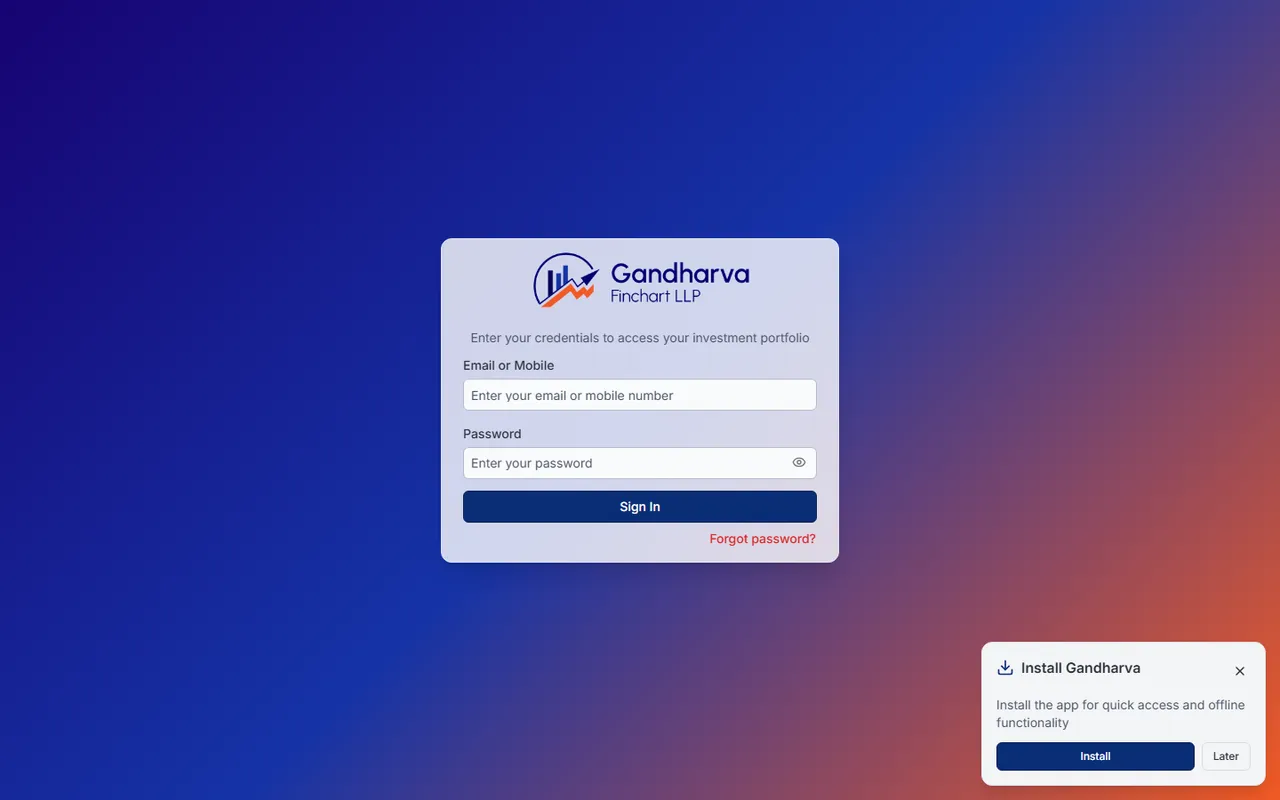
A financial management platform, delivered solo to production for a client.
- Role
- Solo delivery — design, build, deploy, support
- Source
- Client engagement
01
Context & my role
Role: Solo delivery — design, build, deploy, support
02
Problem
A financial services client needed one system for client onboarding, investment requests, transactions, withdrawals and payouts — replacing spreadsheets and manual bank transfers — with the controls an auditor expects.
Delivered as a forward-deployed engineer: requirements workshops on site, HLD/LLD, build, UAT with the client's operations team, production deployment and post-launch support. Confidential details are omitted here.
03
Approach
A React client and an Express API in one TypeScript monorepo share a Drizzle schema, so request and response types are enforced on both sides.
Master tables (`mst_user`, `mst_role`, `mst_role_right`, `mst_module`, `mst_branch`, `mst_client`) drive role-based access down to the module level; every report route is role-scoped.
Money moves through explicit request tables — investment, withdrawal and referral requests — each with its own state machine, before anything becomes a transaction.
04
Architecture
Financial Ledger & Payment Platform
simplified, illustrativeEnterprise payment management backend with Razorpay checkout, idempotent webhook processing, double-entry audit ledger, and two-tier withdrawal approvals.
System Overview & Accessible Text Description
Components: Client Web App (client); API Gateway (gateway); Auth & RBAC Matrix (service); Razorpay Gateway (external); Webhook Ingestion (service); Redis Distributed Locks (cache); Double-Entry Ledger (worker); Payout Maker-Checker (service); MSSQL Transaction DB (db).
Key Data & Auth Flows: Client Web App → API Gateway [HTTPS / REST]; API Gateway → Auth & RBAC Matrix [Token Verify]; API Gateway → Razorpay Gateway [Order Create]; Razorpay Gateway → Webhook Ingestion [Payment Webhook]; Webhook Ingestion → Redis Distributed Locks [Acquire Lock]; Webhook Ingestion → Double-Entry Ledger [Verified Credit]; Double-Entry Ledger → MSSQL Transaction DB [Write Journal]; Client Web App → Payout Maker-Checker [Withdraw Request]; Payout Maker-Checker → Double-Entry Ledger [Approved Payout].
05
Implementation
- 01Razorpay handles collection and payouts; webhook events are the source of truth for a transaction's final state, so a dropped client response can never leave a payment half-recorded.
- 02Audit trails record who changed what on every money-moving entity; transactions carry a GUID for reconciliation with the gateway.
- 03Role rights are data, not code: adding a module or a role is a row in the master tables, surfaced in the admin UI.
- 04Document uploads for KYC and proofs go through Multer with validation on both type and size; indicators and content tables power a CMS-style section for the client's own publishing.
- 05Deployed on the client's Windows hosting with IIS (`web.config`), built with esbuild for the server and Vite for the client.
06
Outcome
- faster client onboarding (engagement)
- 20%
- faster query response (engagement)
- 30%
- uptime (engagement)
- 99%+
- In production at gandharvafin.com, delivered solo from discovery to support.
- Résumé figures from this engagement period: 20% faster client onboarding, 30% faster query response on data-heavy screens, 99%+ uptime.
07
Stack
- React
- TypeScript
- Vite
- Express
- Drizzle ORM
- MySQL
- Razorpay
- JWT
- Nodemailer
Services involved
Skills evidenced: React · TypeScript · Node.js · Express · MS SQL Server · Razorpay · Webhooks · Payouts · Audit trails · RBAC · HLD / LLD · SMS / Email / WhatsApp
Next case study
ModelLabAI →
Zero-code AI analytics: any business file in, dashboards and answers out.